There’s something about discomfort I can’t stop turning over.
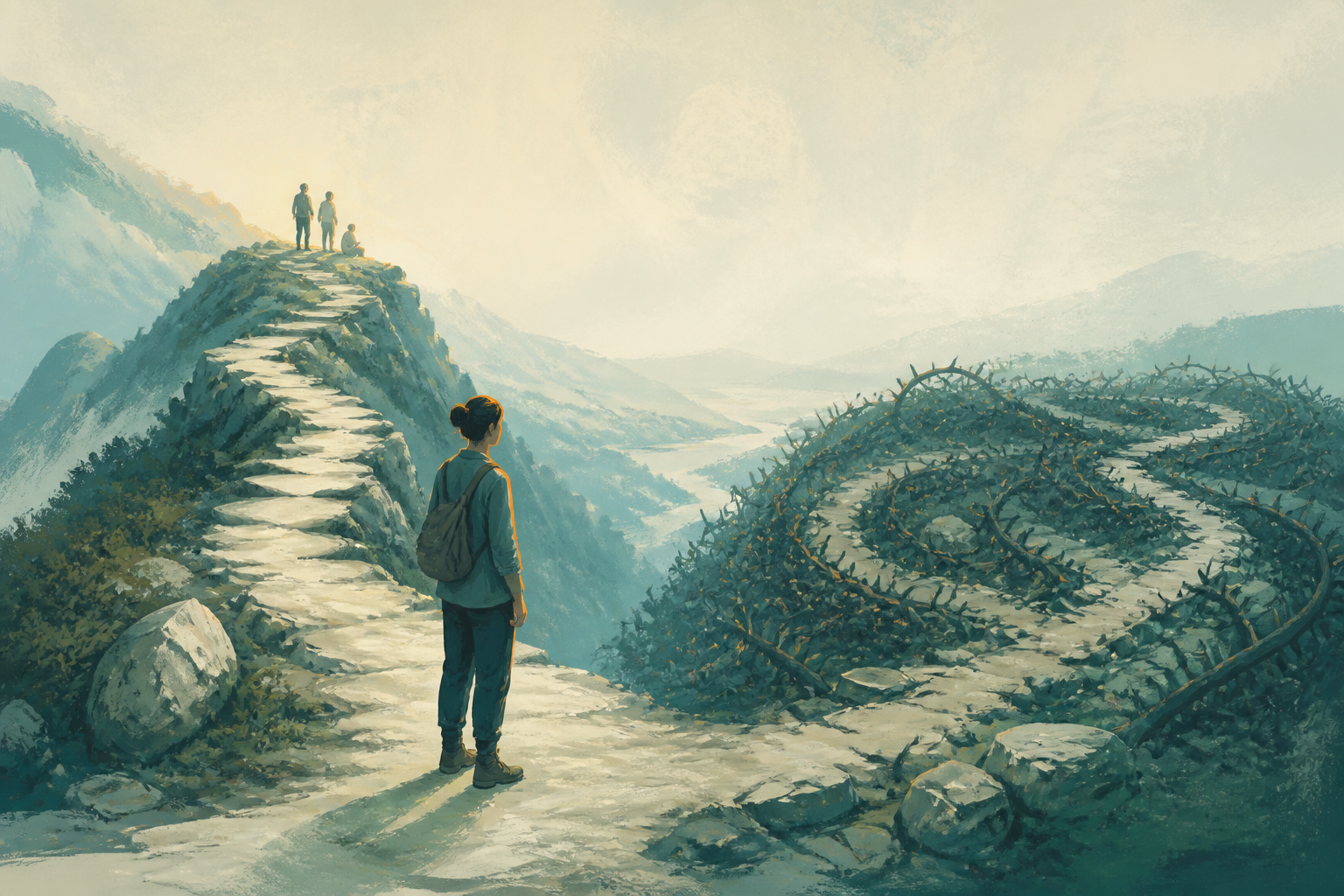
We say stay uncomfortable, that’s where growth happens. That’s true, I’ve said it myself, and I still mostly believe it. But the phrase treats discomfort as one substance, and it isn’t. Some of it builds you into someone better. Some of it grinds you down and hands you nothing at all.
From the inside they feel nearly identical. That’s the whole problem, and it’s why the general advice does as much harm as good.
Three kinds
The first kind has a shape. You’re solving something hard, and the solving teaches you something you’ll use again. How to decide without complete information, or how to get two people who disagree to understand each other. You could name what you’re learning if someone asked over lunch.
The second kind is where the goalposts keep moving. You solve the thing and it turns into a different thing, then another. You’re reacting, not learning, and the discomfort has no shape, just a steady, undifferentiated pressure. From the outside it looks just like the first kind, which is why nobody will rescue you from it. From the inside it’s coping dressed up as growth.
The third kind is an environment that’s simply bad for you. This is where being driven becomes a liability. You talk yourself into believing it’s the first kind. You push through, you tell yourself you’re building resilience, and you break yourself for nothing at all. The damage takes a long time to undo, and you’ll be embarrassed about it afterwards.
Where the framework stops working
The categories aren’t clean. Sometimes the bad environment does teach something real. It can teach you how to stay level when everyone else isn’t, how to hold a boundary under pressure, and how to write an email that protects you without sounding defensive. Those are real capabilities, and you picked them up in the worst classroom available, at a price you wouldn’t have agreed to in advance.
And sometimes the good kind produces nothing. You grind through a hard, well-run project and can’t name a single thing that transfers. Usually that’s because you were executing rather than deciding. Hard work you aren’t making judgement calls inside of doesn’t build judgement, however exhausting it is.
So treat the framework as a rough guide rather than a rule. You can’t wait for the situation to declare itself, because it may never do that. You have to evaluate from inside it, with incomplete information, which is exactly what makes it hard.
The check
If you’ve been uncomfortable for a while, ask whether you can name what you’re learning. I don’t mean “I’m getting tougher”. I mean an actual capability, something you could describe to someone at another company and have them understand without knowing the details of your mess.
If the honest answer is “how to survive this particular situation”, that’s a coping mechanism, not a skill. Coping mechanisms don’t travel with you, and some of them hurt you somewhere healthier.
The second question is whether the discomfort has decreased. Month three should feel different from month one, because you got better, not because the work got easier. If month six feels exactly like month one, there’s no learning curve at all.
The bit I haven’t resolved
Sometimes you’re in the wrong kind of hard and learning something anyway. The project is under-resourced, the goalposts keep moving, and you’re getting skilled at navigating dysfunction. That’s a real skill with real market value. Does that make it the right kind of hard?
There’s an uglier version. What if the discomfort decreased only because you lowered your standards? From the outside that looks exactly like a learning curve, and from the inside on a tired day it can too. That’s surrender, not growth. I don’t have clean answers to either question. What I’m reasonably confident about is the direction of the general claim.
Growth is less about enduring everything than about telling the difference. Stay in the hard that teaches you something, and walk away from the hard that only grinds you down, because you only have so much energy to spend.